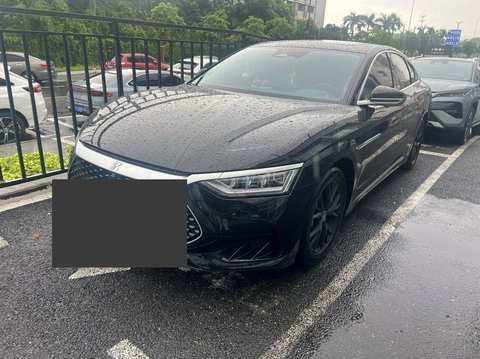
Battery State of Health (SoH) on a used BYD is verified with a manufacturer-level diagnostic scan tool connected to the vehicle's Battery Management System (BMS), which reports the pack's current usable capacity as a percentage of its original rated capacity. This is not a guess or a visual estimate — it is a figure pulled directly from the BMS, the same system that has been monitoring the battery's charge cycles, temperature history, and cell balance since the vehicle left the factory.
SoH is listed on every used-vehicle record we publish, alongside the masked VIN, mileage, condition report note, and owner count. A vehicle showing 100% SoH has a pack performing at its original rated capacity. A vehicle at 90% SoH can still deliver roughly 90% of the range it had when new, under comparable driving conditions. Degradation is a normal part of any lithium battery's life cycle — the question for a buyer is not "has it degraded" but "by how much, and is that acceptable for the vehicle's price and intended use."
Why the percentage matters more than the vehicle's age
Two BYDs of the same model year can carry meaningfully different SoH figures depending on how they were charged, driven, and stored by the prior owner. A vehicle that was mostly slow-charged and driven moderately will typically show a healthier pack than one that saw frequent DC fast-charging and extreme climates, even at similar mileage. This is exactly why we do not rely on year or odometer reading alone — the diagnostic scan is what tells the real story of the pack.
BYD's Blade Battery uses lithium iron phosphate (LFP) chemistry, which is generally recognized for a flatter degradation curve than older nickel-manganese-cobalt (NMC) packs used in many earlier-generation EVs. That does not mean degradation is zero — it means the SoH scan is the tool that quantifies the actual condition of the specific unit in front of you, rather than leaving buyers to extrapolate from chemistry generalities alone.
What the scan actually captures
- Usable capacity as a percentage of original rated capacity (the headline SoH figure)
- Cell balance across the pack's modules, flagged if any imbalance is detected
- BMS fault codes or historical warnings logged by the vehicle's own systems
- Charge cycle count where the tool and vehicle configuration support it
This data is captured before the vehicle is listed and again as part of the pre-export inspection process, so the figure buyers see reflects the vehicle's condition close to shipment, not a stale reading from months earlier.
How buyers should use the SoH figure
Treat SoH as one input alongside mileage, condition report notes, and remaining battery warranty coverage — not as the only number that matters. A lower-mileage vehicle with a mediocre SoH reading may be a worse buy than a higher-mileage unit with strong SoH, depending on your market's climate and how the vehicle will be used after import. If a specific SoH threshold matters for your business — for resale, fleet use, or financing requirements in your destination market — tell us the number you need before ordering, and we will only offer units that meet it.
For any used BYD Blade Battery unit, remaining coverage under the original 8-year / 150,000 km battery warranty depends on the vehicle's age and mileage against those original terms. Confirm remaining coverage on the specific unit before ordering, since it is prorated from first registration rather than reset at resale.
BYD Global Export is an independent export trading company and is not an authorized dealer or representative of BYD Auto Co., Ltd.
Have a target SoH range or a specific model in mind? Message us on WhatsApp and we will pull matching diagnostic-verified units from current stock.