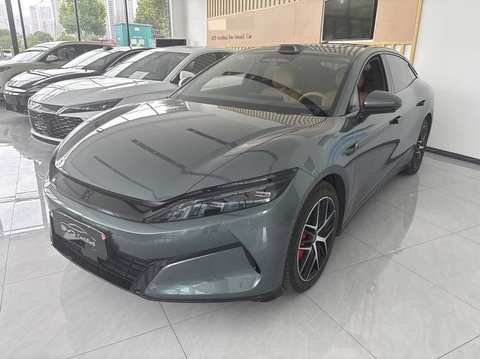
Battery health is the single biggest unknown buyers worry about when considering a used EV, and it's a fair concern - but the data patterns we see across our used BYD inventory are more reassuring than the reputation older EV batteries earned a decade ago. Here's the general framework we use to explain typical degradation, and why we always recommend checking the actual state-of-health (SoH) report over relying on age alone.
Typical Degradation Patterns We See
Across the used BYD units we inspect and offer, two broad patterns show up consistently:
- Lightly used, 1-2 years old, roughly 12,000-22,000 km: typically 96-98% SoH. This is close to negligible degradation - units in this range, like a 2023 Yuan UP at 17,800 km/96% SoH or a 2023 Sealion 6 at 19,700 km/95% SoH, retain nearly all of their original range and performance.
- Higher mileage or ex-fleet, 2-3 years old, roughly 33,000-49,000 km: typically 89-93% SoH. Degradation is more noticeable here but still moderate - a 2022 e6 at 48,500 km/89% SoH, for example, has seen meaningfully more charge cycles and duty (often ex-fleet or ride-hailing use) but still retains close to nine-tenths of its original capacity.
Mileage and duty cycle matter more than calendar age alone within this pattern - a vehicle driven hard and charged frequently in its first two years can show more wear than a vehicle driven lightly for three, which is exactly why we report SoH as a measured figure per unit rather than estimating it from year and mileage.
Why Blade Battery (LFP) Degrades Differently Than Older NMC Packs
BYD's Blade Battery uses lithium iron phosphate (LFP) cell chemistry, which behaves differently under aging than the nickel-manganese-cobalt (NMC) chemistry used in many older-generation EVs. LFP cells are inherently more thermally stable and tolerate a wider range of charge states and full charge cycles with less capacity loss per cycle than NMC chemistry typically shows. This is a large part of why the SoH figures we see on 2-3 year old, higher-mileage BYD units - generally still in the high 80s to low 90s percent range - compare favorably to the steeper early-life degradation curves that gave older-generation NMC-based EVs a reputation for rapid battery fade in their first few years.
The practical effect for buyers is that BYD's Blade Battery degradation curve tends to flatten rather than fall off a cliff in the 2-3 year window - which is exactly the window where a lot of the used inventory we source sits, since fleet and early private-owner vehicles are commonly resold in that range.
Why SoH Verification Matters More Than Calendar Age
The ranges above are useful as a general expectation, but they're patterns, not guarantees for any individual vehicle. Two vehicles of the same model year and similar mileage can have different SoH depending on how they were charged (frequent fast-charging vs. mostly slow/home charging), the climate they operated in, and how consistently they were driven versus left idle for long periods. This is why we don't sell used BYD units off mileage and year alone - every used unit we offer comes with a measured SoH report, not an age-based estimate, so you know the actual remaining battery capacity before you order rather than an inference from the odometer.
What This Means for Your Purchase Decision
If you're evaluating a used BYD EV, treat the SoH percentage as the primary battery-health number and mileage/age as secondary context that helps explain it, not the other way around. A 95%+ SoH unit at 1-2 years old is close to new-condition battery performance. An 89-93% SoH unit at 2-3 years and higher mileage still represents strong retained capacity for the Blade Battery's LFP chemistry, and is worth weighing against its lower landed cost rather than dismissing on mileage alone. Either way, ask for the SoH report before you commit - it's the one number that actually tells you what you're buying.
BYD Global Export is an independent export trading company and is not an authorized dealer or representative of BYD Auto Co., Ltd.
Message us on WhatsApp with the model and unit you're considering, and we'll share the measured battery SoH report before you place an order.